
❋
RESEARCH PROGRAM · FORTIFYU
To understand moral injury in animal care.
A peer-reviewed body of research on the moral cost of animal care work — what it does to the people who do it, why it isn't the same as burnout or compassion fatigue, and what organizations can change.
291
workers, six sectors
(foundational dataset)
5
papers in the pipeline
peer-reviewed & preprint
1
original framework
MIRA
THE WORK
A different premise about the suffering.
For two decades, the distress of animal care workers has been talked about in ways that largely locates the problem inside the worker and asks them, essentially, to cope better. The research at Fortifyu starts somewhere else, with a different premise: that much of this suffering is moral injury, the wound that forms when people who entered this work to protect animals are placed in conditions that force them to participate in, witness, or fail to prevent harm.
Fortifyu has been a pioneer in bringing attention to moral injury in animal care. Its research program tests, empirically, how that injury appears, where it actually comes from, how it differs from burnout, secondary traumatic stress, and compassion fatigue, and which conditions inside organizations make it more or less likely. The findings point consistently outward toward: public hostility, institutional betrayal, and the structure of the work itself, rather than toward any deficiency in the people doing it.
It is rigorous science, held to peer review. It is also written to be read by the people it is about.
ORIGINAL CONTRIBUTIONS
The ideas this work introduced.
❋ FRAMEWORKThe MIRA Framework
Moral injury understood through four integrated domains:
Moral, Identity, Relational, and Agency.
Injury occurs when this system is disrupted: a moral code is violated, identity is threatened, relational bonds are severed, and the capacity to act — agency — is constrained.
❋ NEW TERMMorally saturated environments
A name for workplaces where moral stakes are not occasional but constant — where nearly every task carries the possibility of moral compromise, and exposure becomes chronic rather than acute.
❋ MODELThe three-layer pathway
Outcomes are shaped in sequence: organizational conditions set the exposure a worker meets, the type of exposure determines the kind of harm, and meaning-making capacity decides whether distress resolves or hardens into injury.
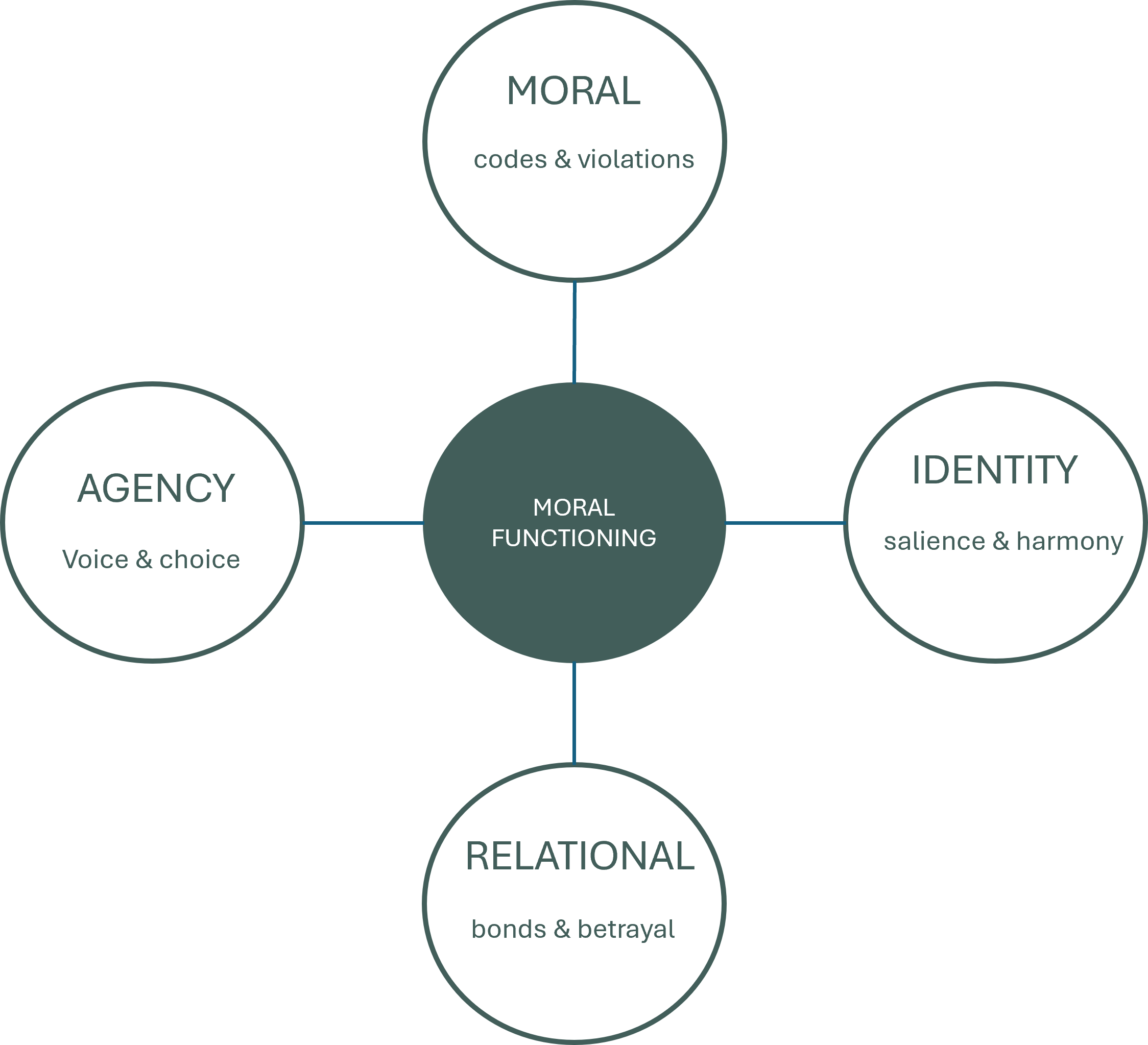
The MIRA framework — Moral, Identity, Relational, and Agency domains surrounding moral functioning. Disruption across these domains is what distinguishes moral injury from burnout.
❋ DISTINCTIONThe agency wound
What separates moral injury from complex trauma: avoidance in moral injury is often other-protective rather than self-protective, and the loss of voice and choice — agency — is a wound in its own right, not a symptom of something else.

PUBLICATIONS
The findings, on the record.
PEER-REVIEWED
Published
McNally J (2026) Moral injury in animal care workers: prevalence, pathways, and phenomenology in a cross-sector sample. Front. Psychiatry 17:1820899. doi: 10.3389/fpsyt.2026.1820899
In ReviewMcNally, J. A. Psychological Trauma: Theory, Research, Practice, and Policy · under revision [2026]Moral injury in animal care workers: prevalence, pathways, and phenomenology in a cross-sector sample
McNally, J. A. Journal of Workplace Behavioral Health · under revision [2026Distinguishing moral injury from burnout, secondary traumatic stress, and depression in animal care workers
In Review PreprintIntroduces the four-domain MIRA framework and traces its development across military, content-moderation, and animal care populations — offering a theory-grounded alternative to definitions of moral injury that lack a model of moral functioning.Locating Organizational Stressors in Animal Care Work: A Cross-Sector Survey
The MIRA framework for moral injury: A moral, identity, relational, and agency model applied across helping professions
❋
NOW RECRUITING · Survey of current and former animal care workers: Moral, Emotional, and Workplace Experiences in Animal Care and Animal-Adjacent Work
Your experience is the data.
A new cross-sector study is documenting moral injury, perpetration, and attrition across every kind of animal care work — shelter and rescue, veterinary, animal control, sanctuary, laboratory, wildlife and conservation, and more. If you work or have worked in animal care, your experience belongs in this research.
This study has been reviewed and approved by [Pearl IRB — protocol #]. Participation is voluntary, responses are anonymous, and you may stop at any time. Questions about your rights as a participant can be directed to [IRB contact]. Questions about the study itself can be directed to Dr. Jamie McNally at [email].
WHO CAN TAKE PART
Anyone who works or has worked in animal care, paid or volunteer, in any sector and any country that can complete a survey in English.
WHAT IT INVOLVES
One anonymous online survey, about [XX] minutes. No identifying information required.
WHY IT MATTERS
The results shape how organizations are asked to change — and what support the field can demand.